RAADS-R Test: Understanding Autism Screening, Its Purpose and Other Autism Tests
RAADS-R Test: Understanding Autism Screening, Its Purpose and Other Autism Tests
Explore adult autism traits, understand what the RAADS-R measures, and discover helpful free neurodivergence screening resources.
Start the Free RAADS-R Test →Raadsrtests.com is an online resource dedicated to adult autism screening and neurocognitive self-assessment. It provides a free RAADS-R-style autism screening experience, alongside other free resources for exploring neurodivergence and overlapping traits. The RAADS-R autism test can help adults reflect on their experiences, communication patterns, sensory differences, and behaviors that may have been present since childhood. Understanding these characteristics can be a useful first step for people who want to learn more about their neurodevelopmental profile.
What Is the RAADS-R Test?
The RAADS-R stands for Ritvo Autism Asperger Diagnostic Scale-Revised. It is an 80-item questionnaire originally developed to help identify autistic characteristics in adults, particularly individuals who may have reached adulthood without receiving an autism diagnosis.
Unlike some short online quizzes that focus mainly on current behavior, the original RAADS-R asks respondents to consider experiences throughout their lives. This lifetime perspective is important because autism is a developmental condition. Characteristics may be noticeable during childhood even when an individual learns to hide, manage, or compensate for them later in life.
The original questionnaire was designed as an assessment aid for clinical settings. Today, RAADS-R-style questionnaires are also available online, allowing adults to explore possible autistic traits privately and conveniently.
What Does the RAADS-R Test Measure?
The original RAADS-R organizes autistic characteristics into four main areas. These categories help describe different aspects of everyday experiences and how someone interacts with their surroundings.
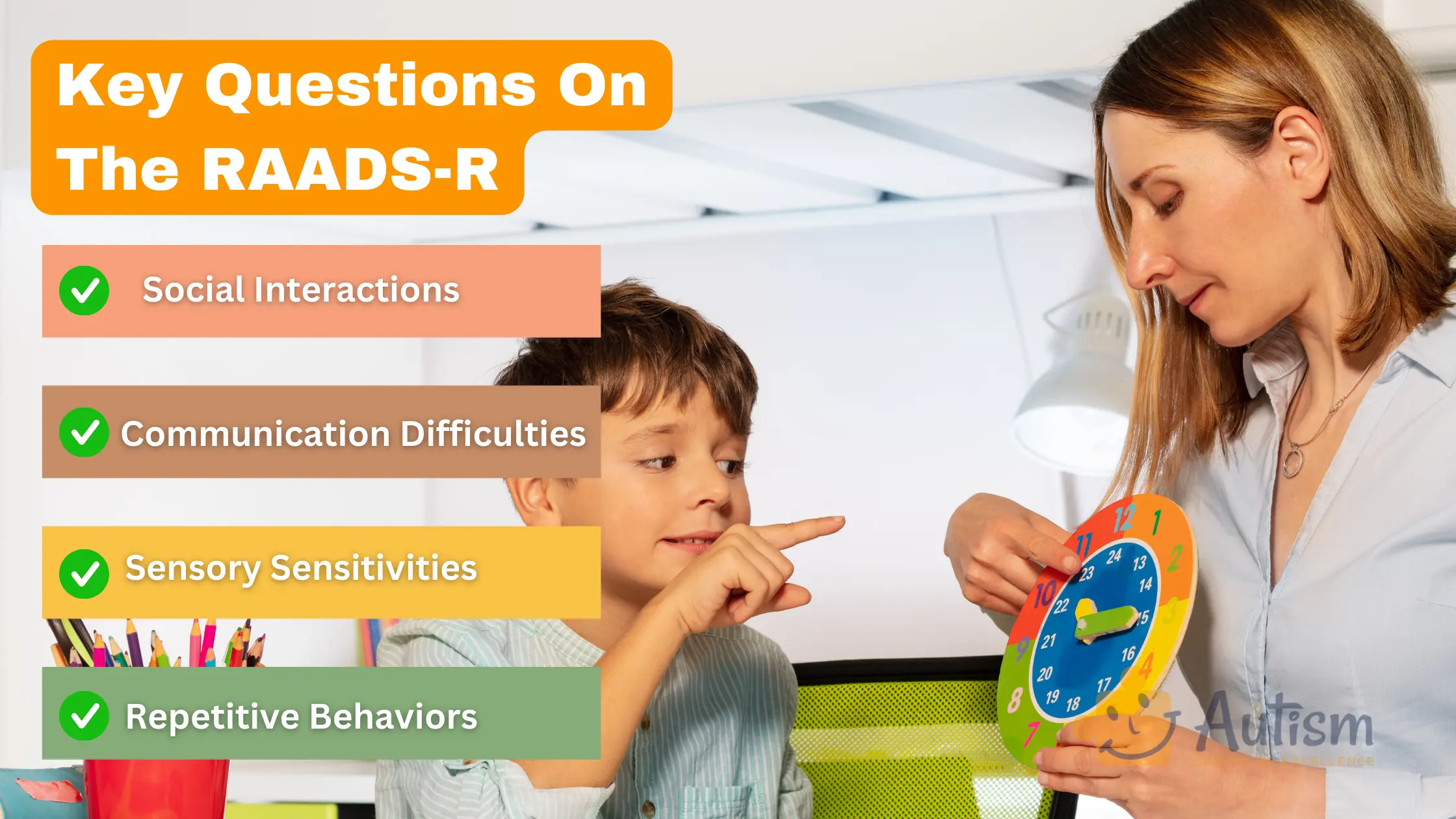
1. Social Relatedness
Social relatedness concerns how individuals understand and participate in social interactions. Some autistic adults find it difficult to interpret facial expressions, understand indirect communication, recognize unwritten social expectations, or maintain conversations in unfamiliar situations.
Other experiences may include feeling exhausted after social activities, preferring meaningful one-to-one conversations, or needing additional time to understand social situations. These differences do not mean someone lacks interest in relationships. People can have strong emotional connections while experiencing social communication differently.
2. Circumscribed Interests
Circumscribed interests refer to highly focused interests or subjects that receive considerable attention. Someone may become deeply interested in a particular topic, spend hours researching it, or enjoy discussing it in great detail.
These interests can provide enjoyment, motivation, expertise, and comfort. However, changing attention from a preferred activity to another responsibility may sometimes be challenging.
3. Language and Communication
The language category explores differences in communication and the interpretation of spoken information. Some autistic people interpret expressions literally, find sarcasm confusing, or prefer direct and precise language.
Others may communicate comfortably about familiar subjects but experience difficulties with vague instructions, small talk, or conversations that involve hidden meanings. Communication styles vary significantly between individuals.
4. Sensory-Motor Experiences
Sensory-motor characteristics involve responses to sounds, lights, textures, smells, physical sensations, and movement. Some people are particularly sensitive to bright lighting, loud environments, clothing textures, or unexpected physical contact.
Others may seek certain sensory experiences, such as repetitive movement or particular sounds. Sensory preferences can influence concentration, comfort, emotional regulation, and everyday activities.
Why Do Adults Take the RAADS-R Autism Test?
Many adults begin exploring autism after recognizing patterns in their lives that they previously struggled to explain. They may have experienced social exhaustion, sensory discomfort, difficulty adapting to unexpected changes, or intense interests from an early age.
Some individuals also discover autism through a family member's diagnosis, conversations with autistic people, or educational information about neurodiversity.
An online screening questionnaire offers a structured way to reflect on these experiences. Rather than relying entirely on memory or general descriptions, individuals can consider specific statements and compare them with their personal history.
- Explore possible autistic characteristics.
- Reflect on childhood and adult experiences.
- Understand social communication differences.
- Recognize sensory preferences and challenges.
- Prepare questions for a qualified healthcare professional.
Is the RAADS-R Test on Raadsrtests.com Completely Free?
Yes. The RAADS-R-style screening test available on Raadsrtests.com is completely free to access. Visitors can explore the questionnaire without purchasing a subscription or paying a fee to complete the screening.
The website also describes its screening experience as private and browser-based, with no account or email registration required. This makes it convenient for adults who prefer to explore their characteristics independently before deciding whether to seek a professional assessment.
A free questionnaire can be a useful educational resource, but its results should always be interpreted carefully. A high score does not confirm autism, and a lower score does not necessarily exclude it. Screening questionnaires cannot replace an individualized clinical assessment.

Other Tests for Autism and Neurodivergence
The RAADS-R is not the only questionnaire used to explore autistic characteristics. Different screening tools focus on different aspects of behavior, communication, attention, and sensory experiences. Some are designed for quick screening, while others provide more detailed information.
1. Autism-Spectrum Quotient (AQ-50)
The AQ-50 is a widely recognized 50-question self-report questionnaire developed to explore autistic traits in adults. It covers social skills, attention switching, communication, imagination, and attention to detail. It can provide an additional perspective when someone is researching possible autistic characteristics.
2. Autism-Spectrum Quotient (AQ-10)
The AQ-10 is a shorter version of the Autism-Spectrum Quotient. It contains ten questions and is used as a brief initial screening tool in some healthcare settings. Its shorter format makes it easier to complete, although it cannot provide the same level of detail as longer assessments.
3. RAADS-14 Screen
The RAADS-14 is a shorter screening questionnaire derived from the original RAADS-R. It focuses on selected autistic characteristics and can be useful when a brief initial screening is preferred. However, it does not provide the full four-area profile of the original questionnaire.
4. Autism Diagnostic Observation Schedule (ADOS-2)
The ADOS-2 is a structured, clinician-administered assessment that involves activities and observations designed to explore social communication, interaction, and behavior. Unlike an online self-screening questionnaire, it requires trained professionals and is used as part of a broader diagnostic evaluation.
5. Autism Diagnostic Interview-Revised (ADI-R)
The ADI-R is a detailed developmental interview that gathers information about a person's early development, communication, social interaction, and behavior patterns. It can help clinicians understand whether characteristics were present during childhood.
6. CAT-Q (Camouflaging Autistic Traits Questionnaire)
The CAT-Q explores masking and camouflaging behaviors. These may include consciously copying social behaviors, rehearsing conversations, or hiding natural responses to fit into social environments. It can be particularly relevant for adults who feel that their outward behavior does not reflect their internal experiences.
Explore More Free Neurocognitive Tests
Autism is only one part of the broader discussion about neurodiversity. Some individuals recognize characteristics associated with several different neurodevelopmental conditions. Exploring related questionnaires may help them understand which experiences they want to investigate further.
Free Neurodivergence Test
Raadsrtests.com also offers a free neurodivergence screening questionnaire. It explores a wider range of characteristics associated with different neurodevelopmental profiles, including autism, ADHD, dyslexia, dyspraxia, and other areas.
This resource can be useful for individuals who are unsure whether their experiences relate specifically to autism or may overlap with other forms of neurodivergence.
Take the Free Neurodivergence Test
Free AuDHD Test
AuDHD is a commonly used community term for the co-occurrence of autism and attention-deficit/hyperactivity disorder (ADHD). Some individuals experience characteristics associated with both conditions, including a combination of sensory sensitivities, attention differences, a need for routine, and difficulties with organization or task initiation.
The free AuDHD screening resource on Raadsrtests.com provides another opportunity to explore these overlapping experiences. It is designed for educational self-reflection rather than diagnosis.
How Should You Interpret Your RAADS-R Results?
It is important to remember that a screening result represents responses to a questionnaire, not a complete understanding of someone's neurological development. Several experiences measured by autism questionnaires can also occur in people with ADHD, anxiety, depression, trauma-related conditions, or other circumstances.
For this reason, a score should not be viewed as a definitive answer. Consider the following when reviewing your results:
- Think about whether the experiences were present during childhood.
- Consider whether they affect different areas of everyday life.
- Look at individual characteristics rather than focusing only on a total score.
- Consider whether other conditions or life circumstances might explain some experiences.
- Discuss important concerns with a qualified healthcare professional.
A professional autism assessment may involve developmental history, clinical interviews, observations, and additional assessment tools. The process should consider the individual rather than relying on a single questionnaire score.
Frequently Asked Questions (FAQs)
1. What does RAADS-R stand for?
RAADS-R stands for Ritvo Autism Asperger Diagnostic Scale-Revised. It is an adult autism screening questionnaire originally developed to explore autistic characteristics across different areas of everyday experience.
2. Is the RAADS-R test free on Raadsrtests.com?
Yes. The RAADS-R-style screening experience on Raadsrtests.com is completely free. Users can access the questionnaire without paying for a subscription or creating an account.
3. Can the RAADS-R test diagnose autism?
No. The RAADS-R is a screening instrument, not a standalone diagnostic tool. A qualified professional must evaluate developmental history, current characteristics, and other relevant information to make a clinical diagnosis.
4. How many questions are in the original RAADS-R?
The original revised RAADS-R contains 80 questions. Online adaptations may use independently written questions based on its general structure, so the exact questionnaire can differ between websites.
5. What are the four areas measured by the RAADS-R?
The original questionnaire covers Social Relatedness, Circumscribed Interests, Language, and Sensory-Motor experiences. These areas describe different characteristics associated with autism.
6. Can adults take an autism screening test?
Yes. Many autism screening tools are designed for adults, including individuals who were not identified during childhood. Adults can use screening questionnaires to reflect on lifelong experiences and decide whether to seek professional guidance.
7. What is the difference between autism and AuDHD?
Autism and ADHD are separate neurodevelopmental conditions that can occur together. AuDHD is an informal community term used to describe someone who experiences characteristics associated with both conditions.
8. What should I do after taking the RAADS-R test?
Review your responses thoughtfully and consider whether the characteristics affect your everyday life. If you have ongoing concerns, discuss your experiences with a qualified professional who has knowledge of adult autism.
9. Can a low RAADS-R score rule out autism?
No. A low score cannot independently rule out autism. Individual differences, masking, interpretation of questions, and the limitations of screening instruments can influence results.
10. Are online autism tests private?
Privacy practices depend on the website. Raadsrtests.com describes its screening experience as browser-based, without requiring an account or email address. Visitors should review the website's privacy information for details.
Conclusion
Understanding autism can be an important part of learning more about personal experiences, communication styles, sensory preferences, and lifelong behavioral patterns. The RAADS-R provides a structured framework for exploring several characteristics associated with autism in adults, while other questionnaires offer additional perspectives on attention, social communication, masking, and neurodivergence.
For people interested in beginning this journey, Raadsrtests.com provides a completely free RAADS-R-style autism screening experience, as well as additional free neurodivergence and AuDHD questionnaires. These resources can help individuals organize their thoughts and identify questions they may want to discuss with a healthcare professional.
Ultimately, no online test can define an individual or replace a professional diagnosis. Screening tools are best used as educational resources that encourage self-understanding, informed conversations, and access to appropriate support.
Ready to Explore Your Autism Traits?
Start with the free RAADS-R-style screening questionnaire and learn more about the characteristics you may recognize in your everyday experiences.
Take the Free RAADS-R Test →
Explore more:
Free Neurodivergence Test
Free AuDHD Test
Comments
Post a Comment